|
A central processing unit (CPU), also called a central processor or main processor, is the electronic circuitry within a computer that executes instructions that make up a computer program. The CPU performs basic arithmetic, logic, controlling, and input/output (I/O) operations specified by the instructions in the program. The computer industry used the term "central processing unit" as early as 1955.Traditionally, the term "CPU" refers to a processor, more specifically to its processing unit and control unit (CU), distinguishing these core elements of a computer from external components such as main memory and I/O circuitry.
|
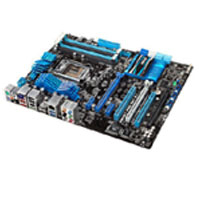 |
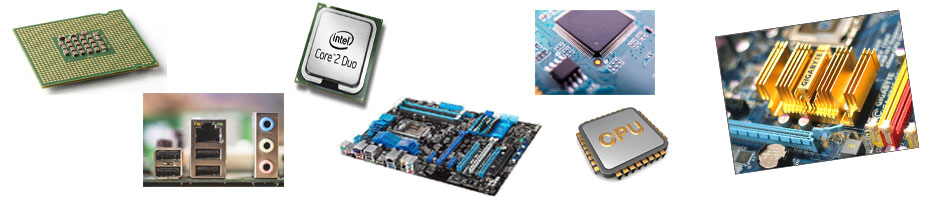
A motherboard (also called mainboard, main circuit board, system board, baseboard, planar board, logic board,and mobo) is the main printed circuit board (PCB) in general-purpose computers and other expandable systems. It holds, and allows communication between, many of the crucial electronic components of a system, such as the central processing unit (CPU) and memory, and provides connectors for other peripherals. Unlike a backplane, a motherboard usually contains significant sub-systems, such as the central processor, the chipset's input/output and memory controllers, interface connectors, and other components integrated for general use. |
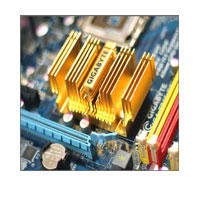 |
In computer architecture, a bus (a contraction of the Latin omnibus, and historically also called data highway) is a communication system that transfers data between components inside a computer, or between computers. This expression covers all related hardware components (wire, optical fiber, etc.) and software, including communication protocols. Early computer buses were parallel electrical wires with multiple hardware connections, but the term is now used for any physical arrangement that provides the same logical function as a parallel electrical bus. Modern computer buses can use both parallel and bit serial connections, and can be wired in either a multidrop (electrical parallel) or daisy chain topology, or connected by switched hubs, as in the case of USB. |
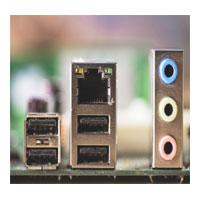 |
In computer hardware, a port serves as an interface between the computer and other computers or peripheral devices. In computer terms, a port generally refers to the part of a computing device available for connection to peripherals such as input and output devices. Computer ports have many uses, to connect a monitor, webcam, speakers, or other peripheral devices. On the physical layer, a computer port is a specialized outlet on a piece of equipment to which a plug or cable connects. Electronically, the several conductors where the port and cable contacts connect, provide a method to transfer signals between devices.
Bent pins are easier to replace on a cable than on a connector attached to a computer, so it was common to use connectors for the fixed side of an interface. |
|