|
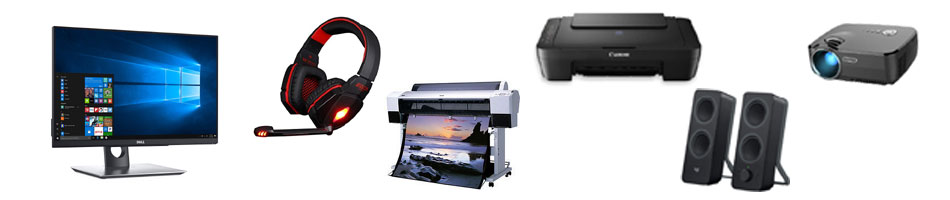
An output device is any piece of computer hardware equipment which converts information into human-readable form. It can be text, graphics, tactile, audio, and video. Some of the output devices are Visual Display Units i.e. a Monitor, Printer, Graphic Output devices, Plotters, Speakers etc.
|
|
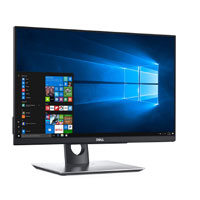 |
A computer monitor is an output device that displays information in pictorial form. A monitor usually comprises the visual display, circuitry, casing, and power supply. The display device in modern monitors is typically a thin film transistor liquid crystal display (TFT-LCD) with LED backlighting having replaced cold-cathode fluorescent lamp (CCFL) backlighting. Older monitors used a cathode ray tube (CRT). Monitors are connected to the computer via VGA, Digital Visual Interface (DVI), HDMI, Display Port, Thunderbolt, low-voltage differential signaling (LVDS) or other proprietary connectors and signals. Originally, computer monitors were used for data processing while television sets were used for entertainment. From the 1980s onwards, computers (and their monitors) have been used for both data processing and entertainment, while televisions have implemented some computer functionality. Modern computer monitors are easily interchangeable with conventional television sets. However, as computer monitors do not necessarily include integrated speakers, it may not be possible to use a computer monitor without external components. |
 |
Headphones are a hardware output device that either plug into a computer line out or speakers. Headphones traditionally refer to a pair of small loudspeaker drivers worn on or around the head over a user's ears. They are electroacoustic transducers, which convert an electrical signal to a corresponding sound. Headphones let a single user listen to an audio source privately, in contrast to a loudspeaker, which emits sound into the open air for anyone nearby to hear. |
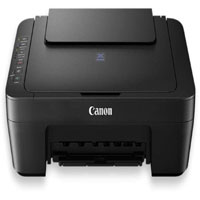 |
A computer printer is a piece of hardware for a computer. It is a peripheral device which makes a persistent representation of graphics or text, usually on paper.While most output is human-readable, bar code printers are an example of an expanded use for printers. The different types of printers include 3D printer, inkjet printer, laser printer, thermal printer, etc.Mostly a printer prints under the control of a computer. Many can also work as a copying machine or with a digital camera to print directly without using a computer. |
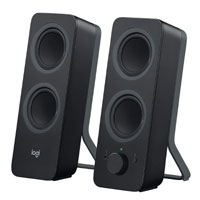 | Computer speakers, or multimedia speakers, are speakers sold for use with computers, although usually capable of other audio uses, e.g. for an MP3 player. Most such speakers have an internal amplifier and consequently require a power source, which may be by a mains power supply often via an AC adapter, batteries, or a USB port. The signal input connector is often a 3.5 mm jack plug (usually color-coded lime green per the PC 99 standard); RCA connectors are sometimes used, and a USB port may supply both signal and power (requiring additional circuitry, and only suitable for use with a computer). Battery-powered wireless Bluetooth speakers require no connections at all. Most computers have speakers of low power and quality built in; when external speakers are connected they disable the built-in speakers. |
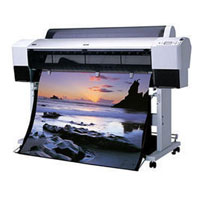 |
A plotter produces vector graphics drawings. Plotters draw lines on paper using a pen. In the past, plotters were used in applications such as computer-aided design, as they were able to produce line drawings much faster and of a higher quality than contemporary conventional printers, and small desktop plotters were often used for business graphics. Although they retained a niche for producing very large drawings for many years, plotters have now largely been replaced by wide-format conventional printers. |
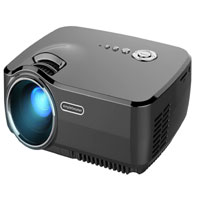 |
A projector or image projector is an optical device that projects an image (or moving images) onto a surface, commonly a projection screen. Most projectors create an image by shining a light through a small transparent lens, but some newer types of projectors can project the image directly, by using lasers. A virtual retinal display, or retinal projector, is a projector that projects an image directly on the retina instead of using an external projection screen.
The most common type of projector used today is called a video projector. Video projectors are digital replacements for earlier types of projectors such as slide projectors and overhead projectors. These earlier types of projectors were mostly replaced with digital video projectors throughout the 1990s and early 2000s, but old analog projectors are still used at some places.
|
|